

For the past few years, much of the conversation around artificial intelligence has focused on what could be lost.
Jobs. Careers. Stability. Predictability.
And for many workers, those concerns are understandable.
AI systems are improving quickly. Tasks that once required hours of human effort can now be completed in minutes. Some companies are already restructuring teams, reducing hiring, or rethinking entire workflows because of AI tools.
That shift feels unsettling for a lot of people.
Especially for workers who spent years becoming highly skilled at structured, repeatable work.
But another question may become increasingly important as AI advances: What human strengths become more valuable because of AI?
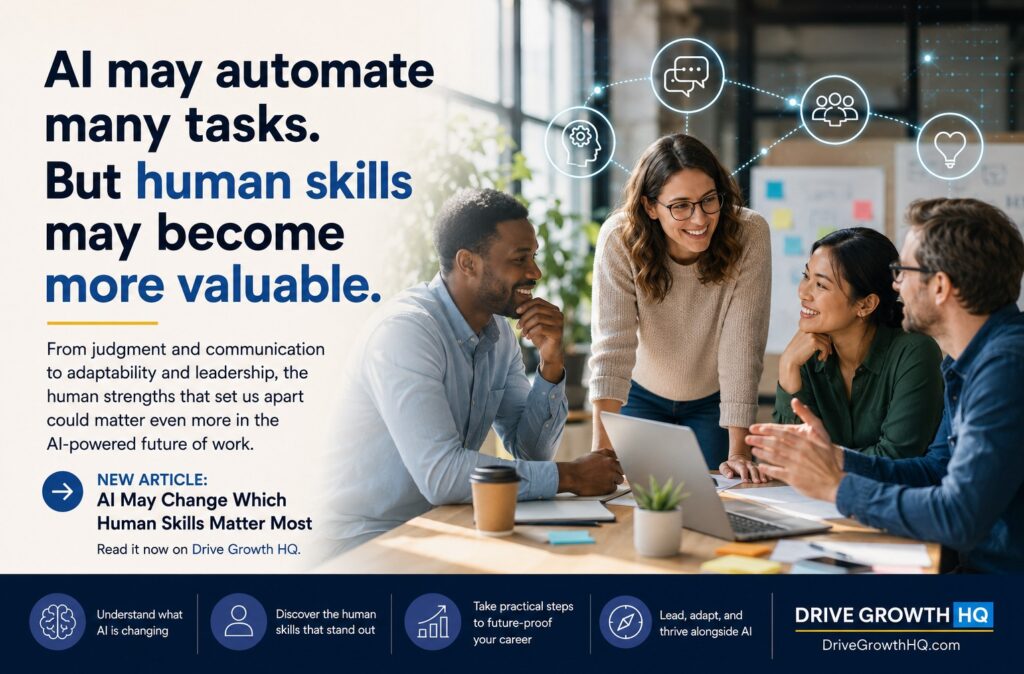
That conversation matters too. Because while AI may automate many technical and repetitive tasks over time, it may also increase the importance of skills that are deeply human — including judgment, communication, adaptability, emotional intelligence, creativity, and leadership.
Not because AI cannot assist with those areas.
But because real life is still filled with nuance, uncertainty, relationships, emotions, and decisions that affect other people.
And that changes how many people may need to think about work moving forward.
Why AI Is Advancing So Quickly at Structured Work
AI Excels at Repetition and Patterns
One reason AI is improving so quickly is that many workplace tasks follow patterns.
That includes things like:
- Summarizing information
- Organizing data
- Writing first drafts
- Generating reports
- Scheduling
- Answering common questions
- Assisting with coding
- Handling repetitive administrative work
AI systems are becoming increasingly good at recognizing patterns and producing structured outputs quickly.
In many cases, they can already help workers complete tasks faster than before. That does not mean AI understands the world the same way humans do. But it does mean that a growing number of tasks can now be partially automated or heavily assisted by software.
And for businesses focused on efficiency, that creates powerful incentives to adopt these tools.
Efficiency Alone May Become Less Differentiating
For years, many careers rewarded people who could:
- Process information quickly
- Follow structured systems
- Produce consistent outputs
- Improve efficiency
- Execute repeatable tasks reliably
Those skills still matter. But AI may reduce how rare some of those abilities become. If nearly everyone has access to powerful AI assistance, then speed and output alone may become less differentiating over time.
That does not mean human workers stop being important. It may simply mean that different human strengths begin standing out more.
The Human Skills That May Become More Valuable
Judgment Still Matters in the Real World
AI can generate answers. But knowing which answer makes sense in a real-world situation is often more complicated.
Good judgment involves:
- Understanding context
- Recognizing risk
- Balancing tradeoffs
- Thinking ethically
- Making decisions under uncertainty
That is difficult to automate fully. A manager deciding how to handle layoffs. A doctor speaking with a worried patient. A business owner navigating financial pressure. A parent making decisions about their child’s future.
These situations involve emotion, nuance, responsibility, and human consequences. And those things are not easily reduced to patterns alone.
As AI becomes more common, judgment may become even more valuable — not less.
Communication Is More Than Delivering Information
AI can already help people write emails, reports, presentations, and marketing copy. But communication is not only about producing words.
It is also about:
- Trust
- Tone
- Timing
- Persuasion
- Empathy
- Leadership
- Understanding people
A difficult conversation with an employee, a teacher encouraging a struggling student or a leader calming a nervous team during uncertainty. Those moments require emotional awareness and human connection.
People often remember how someone made them feel just as much as what they said. That is one reason communication may remain a major advantage in an AI-assisted world.
Adaptability May Become a Major Advantage
Many workers grew up preparing for stable career paths…Learn a skill. Build experience. Improve over time. Stay in the same field for decades.
But AI may accelerate change across industries faster than many people expected. That means adaptability could become increasingly important. Not everyone will need to become an AI engineer.
But many people may need to become more comfortable:
- Learning new tools
- Adjusting workflows
- Changing responsibilities
- Continuing to evolve professionally
That can feel exhausting at times. But adaptability has always mattered during periods of major technological change. And workers who stay flexible often position themselves better for long-term shifts.
Emotional Intelligence Still Shapes Human Relationships
Many jobs involve more than technical execution. They involve people.
Healthcare workers support patients during stressful moments, teachers guide students emotionally as well as academically, managers help teams navigate pressure, burnout, and uncertainty, and customer-facing roles often depend heavily on patience, empathy, and trust.
AI may assist many of these professions. But human relationships still matter deeply in the real world. People often want reassurance from another human being during difficult situations.
They want to feel understood. They want trust. And emotional intelligence continues to shape how people work together, solve problems, and build relationships.
Creativity Is More Than Generating Content
AI can now generate images, music, writing, videos, and ideas very quickly. That has created understandable anxiety among many creative professionals. But creativity is not only about producing content.
It is also about:
- Originality
- Perspective
- Lived experience
- Taste
- Intuition
- Storytelling
- Understanding culture and emotion
AI can remix patterns from existing data extremely well. But humans still bring personal experience, emotional depth, and meaning into creative work. That difference may continue to matter more than many people realize.
Leadership May Matter Even More in an AI World
Periods of rapid change often increase the need for leadership.
People look for:
- Clarity
- Confidence
- Direction
- Accountability
- Emotional stability
And uncertainty tends to increase those needs even further.
AI may automate many tasks. But people still want human leaders they trust. Especially during moments of transition.
Strong leadership is not just about intelligence or technical skill. It is often about helping people navigate uncertainty together. That may become increasingly important in the years ahead.
AI May Change What Valuable Work Looks Like
Knowledge Alone May Become Easier to Access
For much of modern history, access to information created major advantages.
Today, AI tools can already help people:
- Research topics quickly
- Summarize complex information
- Generate ideas
- Answer technical questions
- Assist with analysis
That does not make expertise irrelevant. But it may change how expertise creates value.
If information becomes easier to access, then interpretation and decision-making may become more important differentiators.
Human Differentiation May Shift Toward Interpretation and Trust
As AI systems become more capable, many workers may find themselves shifting away from purely repetitive execution and toward:
- Strategic thinking
- Relationship-building
- Interpretation
- Collaboration
- Oversight
- Decision-making
In other words, human value may increasingly center around:
- Understanding context
- Connecting ideas
- Building trust
- Guiding people
- Making responsible decisions
Those skills are harder to measure than raw productivity. But they may become increasingly important as AI spreads across industries.
This Does Not Mean Technical Skills Stop Mattering
AI Will Likely Amplify Many Skilled Workers Too
Technical skills are still extremely valuable.
In many industries, AI may actually increase the productivity of:
- Engineers
- Analysts
- Marketers
- Designers
- Researchers
- Healthcare professionals
- Business operators
Workers who understand both their field and AI tools may gain significant advantages. This is not a future where human expertise disappears. It is more likely a future where humans and AI increasingly work together.
The Bigger Shift May Be How Humans and AI Work Together
The conversation should probably not be framed as: “Humans versus AI.”
A more realistic question may be: Which human strengths become more important in a world where AI handles more routine work?
That is a very different conversation. And it may lead many people to rethink what long-term career value actually looks like.
What People Can Do Right Now
Learn How to Work Alongside AI
Ignoring AI completely may become increasingly difficult. But blindly depending on AI for everything is probably not the answer either.
A healthier approach may involve:
- Understanding what AI does well
- Recognizing where human judgment still matters
- Learning how to use AI tools responsibly
- Improving productivity without losing critical thinking
Workers who learn how to collaborate with AI effectively may place themselves in a stronger position moving forward.
Strengthen Human Skills That Build Trust
Technical ability still matters.
But many people may also benefit from strengthening skills like:
- Communication
- Emotional awareness
- Leadership
- Collaboration
- Adaptability
- Problem-solving
These are often the skills that shape trust, relationships, and long-term opportunities. And those strengths may become increasingly valuable as automation expands.
Stay Adaptable as Work Continues to Change
Nobody knows exactly how quickly AI will reshape different industries. Some predictions may prove exaggerated. Others may arrive faster than expected. But it is becoming harder to ignore the direction technology is moving.
That does not mean people should panic. It does mean adaptability may become one of the most important long-term advantages a person can develop.
The Future of Work May Reward Different Human Strengths
AI may change many aspects of work over the next decade. Some jobs will likely evolve significantly. Some tasks may become heavily automated. And many industries may continue changing faster than workers expect.
But the future of work may not simply reward the people who can produce the most output.
It may increasingly reward the people who can:
- Think clearly
- Adapt quickly
- Communicate effectively
- Build trust
- Solve difficult problems
- Lead responsibly alongside AI
In a world where machines can increasingly generate information and automate routine tasks, deeply human strengths may become more valuable — not less.
And that may become one of the most important workplace shifts of all.
