

Artificial intelligence used to feel far away for most people.
It felt like something connected to tech companies, research labs, or futuristic conversations that had little to do with everyday life.
That has changed.
Now AI is showing up almost everywhere.
People are using it at work without fully talking about it yet. Companies are experimenting with it quietly behind the scenes. Students are relying on it for schoolwork. Managers are being told to improve productivity with it. Businesses are trying to figure out where they can reduce time, labor, or cost.
And somewhere along the way, many people started asking themselves a question they never expected to ask:
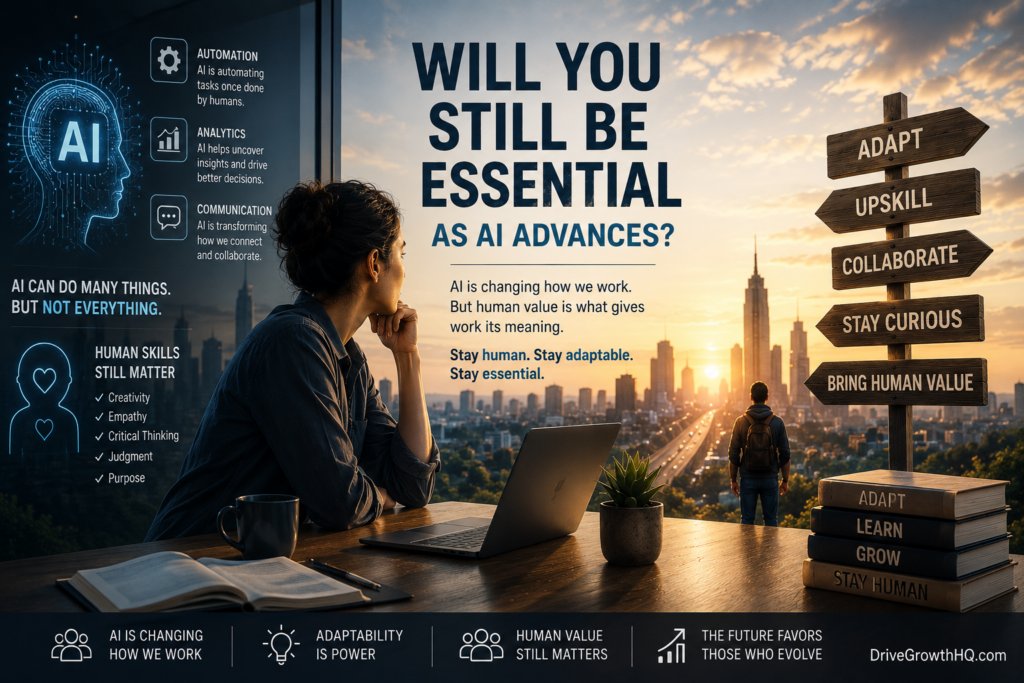
Will I still be essential as AI advances?
Not just at work.
But economically.
Personally.
Long term.
For decades, most people believed technology would mainly replace repetitive physical labor.
Factory work.
Assembly lines.
Manual processes.
Meanwhile, knowledge workers, professionals, creatives, and educated office workers were often told their expertise would protect them.
That assumption is beginning to change.
Today, AI can:
- Write reports
- Summarize meetings
- Answer customer questions
- Generate code
- Analyze legal documents
- Create marketing campaigns
- Produce images and videos
- Tutor students
- And increasingly assist with tasks once considered deeply human.
That does not mean AI is replacing all jobs tomorrow. But it does mean many people are beginning to wonder whether the skills that once made them valuable will continue to matter at the same level in the years ahead. And that uncertainty is creating something bigger than job anxiety. It is creating identity anxiety.
This Shift Feels Different
Every major technological shift changes work, but this one feels different to many people.
The industrial revolution transformed physical labor. The internet changed communication and access to information. Computers automated countless business processes and workflows.
But AI touches something many people believed would remain uniquely human for much longer: thinking itself.
That is what makes this moment feel emotionally unsettling for so many workers and professionals.
For years, people were told:
- Learn more
- Build expertise
- Go to college
- Become specialized
- Work with information
- Move into knowledge-based careers
Now many of those same people are watching AI systems complete tasks they spent years learning how to do. Not perfectly, and not independently, but increasingly well and increasingly fast.
That changes how people think about long-term security.
A customer support representative may wonder how quickly chatbots continue improving. A software engineer may question how much code AI will eventually generate. A copywriter may notice clients asking for fewer revisions because AI now handles early drafts. An accountant may see automation quietly entering reporting and compliance workflows.
Even doctors, lawyers, teachers, and executives are beginning to realize AI is no longer limited to repetitive or routine work.
The concern is no longer simply, “Can AI do this?”
The concern is becoming, “How much of this can AI eventually do well enough?”
That is a very different question.
AI Is More Likely To Replace Tasks Before Entire Jobs
One of the biggest misunderstandings in the AI conversation is the idea that jobs disappear overnight.
In reality, work usually changes gradually.
Most jobs are made up of many smaller tasks.
Some of those tasks are highly repetitive.
Others require:
- Judgment
- Trust
- Emotional intelligence
- Creativity
- Leadership
- Negotiation
- Accountability
- Or human connection
AI tends to move into the repetitive and predictable parts first. That matters because many people may not lose their jobs immediately — but they may lose parts of what once made them valuable.
An entry-level analyst may spend less time preparing reports because AI handles the first draft. A marketer may create campaigns faster using AI tools. A recruiter may rely on AI screening systems. A teacher may use AI-assisted lesson planning. A lawyer may review contracts with AI support.
The role still exists. But the workflow changes. And once workflows change, expectations often change too.
Companies begin asking:
- Why do we need as many people?
- Why does this process take so long?
- Can one person now do the work of three?
- Which roles are becoming less essential?
That is where the real disruption begins. Not necessarily with total replacement. But with reduced demand for certain kinds of human labor.
The Most Vulnerable Work Is Often Predictable Work
Many people assume AI only threatens low-paying or repetitive jobs.
That is no longer true.
AI increasingly affects work that is:
- Structured
- Rules-based
- Pattern-driven
- Information-heavy
- Or digitally repeatable
That includes parts of:
- Accounting
- Law
- Software development
- Customer service
- Administration
- Finance
- Education
- And marketing
This does not mean those professions disappear. But it does mean portions of them may become heavily automated or dramatically compressed. Entry-level roles may be especially vulnerable.
Historically, junior jobs allowed people to:
- Learn the business
- Gain experience
- Develop judgment
- And gradually move upward
AI may reduce the need for some of those stepping-stone tasks. That creates a larger societal question: What happens when fewer people are needed to learn the basics? That issue does not get enough attention. Because if AI removes too many entry-level pathways, companies may eventually struggle to develop future experts and leaders.
The Emotional Side Nobody Talks About Enough
Many AI discussions focus on productivity.
Or innovation.
Or investment.
But for millions of people, the emotional question is much simpler: “Will I still have value?”
That fear is not irrational.
Work is tied to:
- Identity
- Confidence
- Stability
- Purpose
- And self-worth
People do not just want income. They want to feel useful, needed, and respected. And AI challenges some of the assumptions many people built their careers around. Someone who spent 20 years becoming highly skilled in a field may suddenly watch AI complete parts of that work in seconds. That can feel deeply destabilizing.
Especially for people who:
- Built identities around expertise
- Supported families through specialized knowledge
- Or believed experience alone guaranteed long-term security
This emotional layer matters. Because adaptation is not only technical. It is psychological.
What Still Makes Humans Essential?
This is the part many people want answered immediately.
And the honest answer is: nobody fully knows yet. AI capabilities are evolving extremely quickly. But there are still areas where humans remain uniquely important. At least for now.
These include judgment
AI can generate options.
Humans still carry responsibility for decisions.
Especially where:
- Ethics
- Risk
- Ambiguity
- And consequences matter
Trust
People still trust people.
Especially during:
- Uncertainty
- Conflict
- Healthcare decisions
- Financial decisions
- Leadership
- And emotional moments
Human Connection
Relationships still matter.
Empathy still matters.
Context still matters.
A machine may answer questions.
But humans still understand nuance, emotion, and lived experience in ways AI does not fully replicate.
Creativity With Context
AI can generate enormous amounts of content.
But humans still:
- Connect ideas
- Create meaning
- Understand culture
- And recognize what emotionally resonates.
Leadership
Organizations still need people capable of:
- Guiding teams
- Making difficult decisions
- Building trust
- And navigating uncertainty.
The future may not belong to people who avoid AI. It may belong to people who learn how to combine human strengths with AI capabilities.
The People Most At Risk May Not Be Who We Expect
One of the most surprising aspects of the AI shift is that highly educated knowledge workers may experience more disruption than many people expected.
For years, automation mainly targeted repetitive physical labor. AI, however, is increasingly targeting cognitive workflows and information-based work. That changes the equation significantly.
At the same time, some skilled trades and hands-on professions may remain more protected for longer because physical-world complexity is still difficult for AI-powered robotics to fully handle.
That does not mean blue-collar workers are permanently safe or that white-collar workers are automatically doomed. It simply means many of the traditional assumptions people held about “safe careers” may no longer apply in the same way moving forward.
The future may increasingly reward:
- Adaptability
- Interdisciplinary thinking
- Emotional intelligence
- Communication
- Systems thinking
- And human-centered problem solving
Not just raw technical expertise.
What Happens If You Ignore The Shift?
This is another uncomfortable question for many people.
Some hope AI progress will slow down. Others believe the technology is still overhyped or that regulation and public backlash will eventually limit how far it goes.
But even if development slows at times, the broader direction is becoming increasingly difficult to ignore. AI is steadily moving deeper into work across industries, workflows, and everyday business operations.
At the same time, many workers are already adapting quietly.
Some are learning AI tools after work. Others are experimenting privately because they worry about falling behind. Many still are not sure whether they should fully embrace AI or fear what embracing it may eventually mean for their own profession.
That tension is becoming increasingly common.
The people most vulnerable may not necessarily be those replaced overnight. They may be the people who wait too long to adapt to how quickly expectations, workflows, and business environments are changing.
Because over time:
- AI-assisted workers may become dramatically more productive
- Companies may redesign teams around smaller headcounts
- And expectations for what one person can accomplish may continue rising.
That does not mean everyone must become an engineer or technical expert.
But it likely does mean many people will need to:
- Learn new workflows
- Understand AI tools
- Strengthen human-centered skills
- And become more adaptable.
The workers who succeed may not necessarily be the smartest.
They may be the people most willing to evolve.
Adaptation Does Not Mean Becoming Less Human
There is a growing belief online that people will need to compete with machines by becoming more machine-like themselves. That may be the wrong lesson. The goal should not be removing humanity from work. The goal should be increasing the value of what remains deeply human.
That includes:
- Judgment
- Ethics
- Creativity
- Leadership
- Emotional intelligence
- Communication
- Relationship-building
- And strategic thinking.
As AI advances, another shift may happen quietly in the background.
Expertise may become more abundant.
Writing.
Coding.
Design.
Research.
Analysis.
Tasks that once required years of specialized experience may become easier and faster to produce. When that happens, value often shifts elsewhere.
People may begin valuing:
- Judgment over raw output
- Trust over information
- Originality over volume
- And human connection over efficiency alone.
AI may increase the importance of these qualities rather than reduce them. Especially as automated content, ideas, and outputs become increasingly abundant. When everyone has access to similar AI tools, human differentiation may matter even more.
So…Will You Still Be Essential?
That may ultimately depend on:
- How willing you are to adapt
- How quickly you learn
- How well you combine AI with human strengths
- And whether you continue developing skills machines struggle to replicate.
The future of work may not divide people into: humans versus AI.
It may divide people into:
- Those who learn to work alongside AI
- And those who do not.
None of this guarantees safety, and it certainly does not remove uncertainty. But it does offer a path forward.
The goal is not fear, and it is not pretending nothing is changing either. The goal is awareness.
The people who recognize the shift early and adapt intentionally may have a much better chance of remaining valuable in a world changing faster than most people expected.
The future may not belong to the people who blindly reject AI, and it may not belong to the people who rely on AI for everything. It may belong to the people who stay deeply human while learning how to evolve alongside it.
AI will continue reshaping work. That part is becoming harder to ignore.
But being essential has never only been about completing tasks. It has always been about bringing something meaningful that others cannot easily replace.
The real question now is whether people are willing to evolve alongside it as AI advances.
